

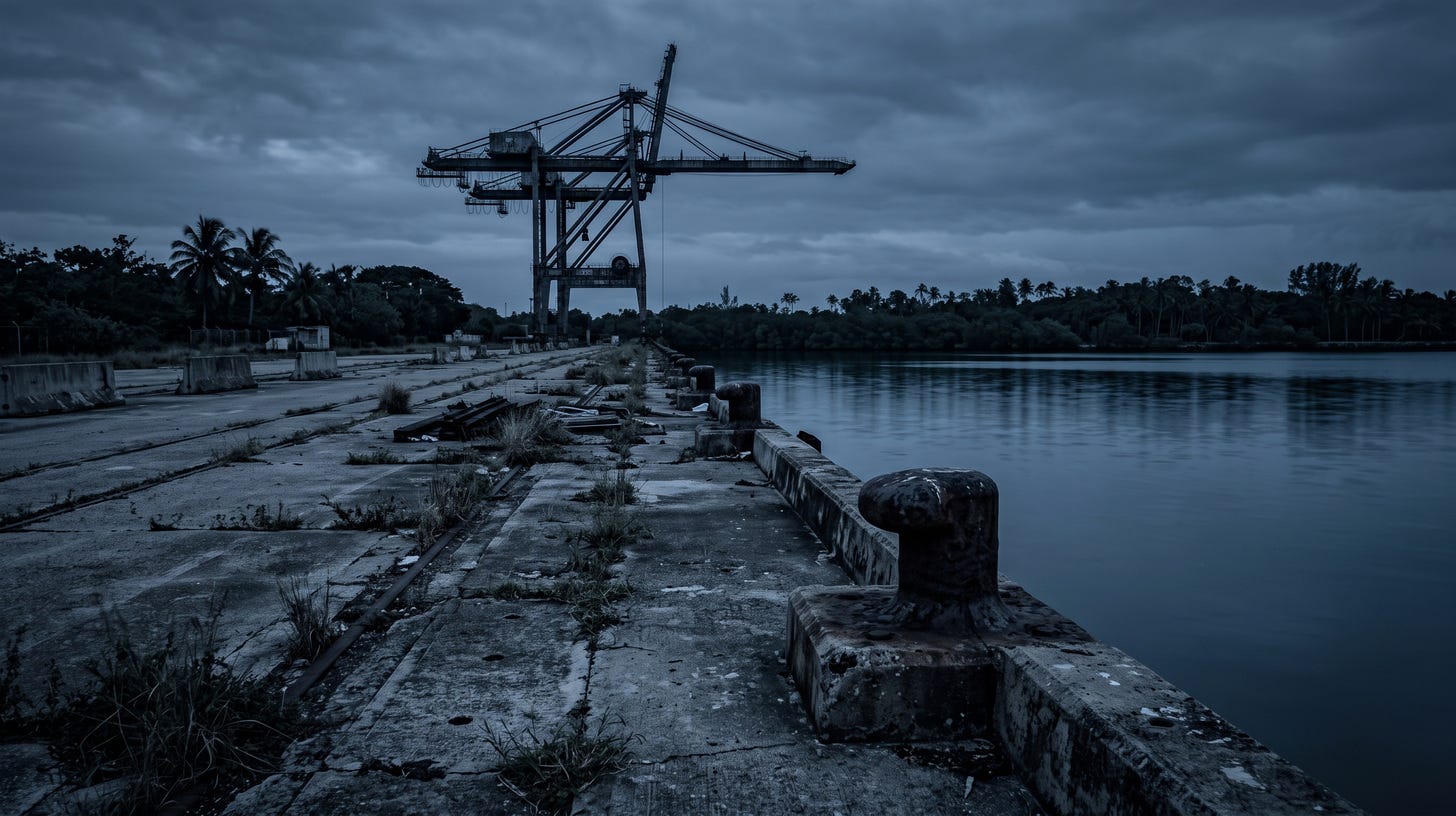
The band was playing before the ship had finished docking.
Morning, 16 January 2019. Officials from the municipality stood along the wharf holding small Philippine flags. Dancers in traditional dress moved down the pier. The souvenir stalls were up, the tour buses were idling, and as the passengers came down the gangway the officials leaned in and put flower garlands around their necks. About three thousand of them, with parasols and camera phones and money to spend.
They had come from mainland China, and the wharf they were standing on was called Alava.
Nuclear-powered aircraft carriers used to tie up there. For most of the twentieth century Subic Bay was the largest American naval base outside the United States, the place the Seventh Fleet went to be trained and repaired and resupplied and rested, and it had a hand in every overseas American military engagement of the century, from the Boxer Rebellion to Desert Storm. Nothing else said as plainly how far American power reached.
The tourists walked off the pier into the middle of it. Past Building 229, the old headquarters, its number still stencilled in black on a peeling white wall. Past the warehouses. Some used the public toilets beside a mini-golf course gone to weed. Others pulled roller suitcases down Dewey Avenue, named for the commander who destroyed the Spanish fleet at Manila Bay in 1898, which is where the American conquest of the islands started.
The base closed in 1992. A volcano did part of it — Pinatubo erupted the previous summer and wrecked the facilities. Filipino nationalism and the end of the Cold War did the rest. For the first time in four centuries there were no foreign troops in the Philippines.
In February 1992, nine months before that flag came down at Alava Wharf, China’s legislature had passed the Law on the Territorial Sea and the Contiguous Zone, claiming more than eighty per cent of the South China Sea.
The claim was made while the Americans were still packing.
In June 1866, six Frenchmen left the waterfront at Saigon in two small steam gunboats with twenty crew and a great deal of liquor, and went looking for a way up the Mekong into China.
They were after a back door. If France could open a trade route from Cochinchina into southern China it would check the British advance and pay for an empire. What they found was rapids. The expedition stalled at Sambor in what is now northern Cambodia, then again at the Khone falls near the Lao border, and the idea of moving cargo up that river died there. Their leader died too, of a bad liver, in a Yunnanese town in 1868. Seventy years on, a British naval handbook noted that Saigon to Luang Prabang by river still took longer than Saigon to Marseille by sea.
The mountains between China and the lands below it had held for a very long time. James C. Scott called that upland belt Zomia and described it as the largest region on earth whose peoples had never been folded into states.
That barrier is now going. Chinese firms have opened the upper Mekong to commercial traffic and are building a high-speed line from Kunming to Vientiane. John Garver’s phrase for what the money buys is the technological subjugation of terrain. The historian Thant Myint-U, travelling through northeastern Burma, described the reversal it produced: places that had been remote were now close to the new centre, and mountain hamlets were more modern than Rangoon. Buy a bottle of water in Lashio or Luang Namtha and it probably came from China.
The French wanted this and could not have it. China wants it and can.
Here is the thing the rivalry framing gets wrong, and it is not a small thing.
Look at the map from Beijing rather than from Washington. China has land borders with fourteen countries, two of them nuclear-armed rivals. Off its east coast runs an island chain from Kamchatka down to Borneo, and three of the links in that chain are American treaty allies, with Taiwan alongside them. A strategist at China’s National Defence University put the problem plainly: a country bordered by great powers on land and fenced by islands at sea has never been able to draw benefit from having both.
North is Russia. East is the chain. West is mountain and desert and India. There is one direction that is not closed, and it is south.
Then add the arithmetic that makes it urgent. Around seventy per cent of China’s oil is imported, and roughly eighty per cent of that comes through the Straits of Malacca, a channel carrying about a quarter of world trade and a third of the world’s crude and refined fuels, which has long made it the second most important oil transit chokepoint on earth after Hormuz. In November 2003 Hu Jintao said certain major powers were bent on controlling the straits, and his phrase for the problem has stuck to it ever since: the Malacca dilemma. China’s entire industrial existence runs through a stretch of water it does not control and could not hold.
And the chute is filling. In 2025 the strait took 102,525 vessel transits, passing a hundred thousand for the first time and running almost nine per cent above the year before. The Malaysia Maritime Institute puts its capacity at 122,600. On the current curve that ceiling is roughly three years away.
So the southward push is not appetite. It is an attempt to build, out of pipelines and railways and dredged sand, the western coastline China does not have — and to put a navy in the water that can keep the sea-lanes open without asking anyone. The same logic that turns a shipping lane into an instrument of policy works in reverse when you are the one whose oil is in the hold.
Which is why people keep trying to dig around it.
At the Kra Isthmus, the narrow stem of southern Thailand dividing the Gulf of Thailand from the Andaman Sea, there is a line on a map that has been drawn and abandoned for two and a half centuries. King Rama I conceived a canal there in the late 1700s as a defence against Burmese attack. In 1855 the British governor of Hong Kong came home from Siam and wrote that a channel through the collar of Kra would rank with the schemes proposed at Suez and Panama, shortening the run from India to eastern Asia not by days but by weeks. The Americans ran a feasibility study in 1972 and dropped it. By one count more than twenty-five studies have been commissioned. None has got past the earliest stage.
In an office in the Latphrao district of Bangkok, a man in his seventies named Pakdee Tanapura has been lobbying for it since the 1970s. He has written the books and run the conferences, and he clicks through a slideshow promising three million jobs in southern Thailand and infrastructure stock that lasts hundreds of years. It would take a channel of 135 kilometres, deep enough for tankers.
Nobody has ever cut it. What is new is that for the first time there is a country with both the reason and the money.
This is worth stating carefully, because it is a mechanism and not an excuse. A state that is enclosed will push at the one place it is not enclosed. It will do this whether its leadership is aggrieved or magnanimous, communist or otherwise. The push is structural. What is chosen is only how hard.
Which brings the argument to the part that almost nobody writes about.
The standard account has two actors. Washington and Beijing, a rising power and an incumbent, a contest whose outcome will be settled between them. Southeast Asia appears in that account as terrain — the board, not a player.
The eleven countries on that board hold 650 million people and the world’s fifth-largest economy, projected to be fourth by 2030. They sit on the sea-lane. Every one of them has to decide, continuously and in detail, what to permit and what to refuse, and those decisions are what the contest actually consists of. A survey of regional experts and officials in late 2019 found around thirty-eight per cent expecting China to become a revisionist power intent on making Southeast Asia its sphere of influence, and fewer than one in ten seeing it as benign. They are not naive about what is happening to them. They are also not going to choose.
They will not choose because their position forbids it, and because their responses are not one response. Vietnam’s entire history runs on the tension between copying China and resisting it. Burma’s unease about Chinese influence helped push it toward the West. Beijing’s conduct at sea has put protesters on the streets in Manila and Hanoi.
Cambodia went the other way, and the ledger the book sets out is unusually legible. Chinese money became the top source of trade, then investment, then aid, then tourists, along with uniforms, trucks, loans for helicopters and a training facility in the south. In return: the Dalai Lama barred from visiting, Falun Gong activists sent back, and in December 2009 twenty ethnic Uighur Muslims deported to China — people who had come out of Xinjiang after the riots there that year, by a long and dangerous route, and asked Cambodia for asylum. Washington cancelled a shipment of military trucks in response. Beijing offered a larger shipment of Dongfeng trucks in their place. In July 2012, chairing ASEAN, Cambodian officials worked behind the scenes to veto mild criticism of China’s seizure of Scarborough Shoal, and for the first time in forty-five years the bloc failed to issue a joint communiqué. As the need for Western approval fell away, so did the pretence of democracy, until the ruling party won every seat in parliament in 2018.
Malaysia refracted the same light differently. Under one government it became the largest recipient of Belt and Road financing of any country in the world except Pakistan — a $16.1 billion east coast rail link, and a $10.4 billion scheme to rebuild Malacca itself as a hub on three reclaimed islands. Under the next, the debt helped bring the government down.
Same pressure. Eleven different refractions of it. Machinery that produces outcomes nobody in any capital selected is not a metaphor here; it is a description of how a region with no common answer generates a common result.
And the American framing makes this worse rather than better. When officials describe the contest in civilisational terms, as a choice between free and repressive visions of world order, they are demanding precisely the thing the region has spent fifty years arranging not to do.
November 2019, Bangkok, the 35th ASEAN Summit. In place of Donald Trump, Mike Pence and Mike Pompeo, the United States sent a low-level delegation under Robert O’Brien, made national security advisor weeks earlier. Between 2011 and 2016 Barack Obama had missed one such meeting. The ambassadorships to Singapore and to ASEAN itself had been vacant since the start of the term, Cambodia had no American ambassador for nearly a year, Thailand for longer. That same year the Indo-Pacific Strategy Report called the region the single most consequential one for America’s future.
The administration was not absent, to be fair about it — defence officials toured, the security guarantee was extended over the Philippines’ portion of the sea, freedom of navigation operations were stepped up, and the Asia Reassurance Initiative Act authorised $1.5 billion a year. Set beside Belt and Road, a rounding error.
An ISEAS survey in early 2020 found around seventy-seven per cent of more than 1,300 regional academics and officials saying American engagement had decreased, and close to half with little or no confidence in Washington as a security partner. The region was being asked to pick a side by a power that could not fill its embassies.
Strangio’s warning is that presenting Chinese activity as a simple story risks producing a self-fulfilling prophecy that ends up serving Beijing. That is the shape this publication keeps finding — the instrument that produces the thing it was built to prevent — and it is worth naming once and then setting down, because it is the least interesting thing in the story.
Which brings us to this year.
The Philippines holds the ASEAN chair in 2026, and its foreign secretary, Theresa Lazaro, has said the bloc and China will move the working-group meetings from once a quarter to once a month to get the South China Sea Code of Conduct finished this year. The code is meant to set rules of behaviour and reduce the chance of a collision becoming something worse.
Set that against the calendar. China’s claim over most of the sea was passed into law in February 1992. ASEAN’s declaration on the South China Sea followed in July of the same year. A single draft text was agreed in 2018, with a three-year deadline running from 2019. It is now 2026 and the central question — whether the thing will be legally binding at all — remains open, because ASEAN has always insisted on it and Beijing has never accepted it.
Thirty-four years. One side legislates; the other declares.
The code is not a settlement of who owns what, and treating its completion as a finish line misreads what it is. It is a test of whether a bloc built on consensus can convert its habits into restraint. And the thing that lets ASEAN hold eleven clashing sovereignties together — decision by consensus — is the same thing that can freeze it when one member has reasons to say no. Enlargement in the 1990s made the region look more coherent and made agreement harder. That is not a flaw somebody introduced. It is the price of the design.
There is a serious objection to everything above, and it comes from the region itself.
Structural explanation slides very easily into exculpation. If China pushes south because it is enclosed, then everything done in the course of it becomes weather rather than conduct — things that happen, rather than things done.
On 2 May 2014 a state-owned deep-water rig, the Haiyang Shiyou 981, was placed in contested water 222 kilometres off the coast of central Vietnam, inside the Vietnamese exclusive economic zone. There was little oil there worth drilling for; the book reads the placement as brinkmanship rather than commerce. Vietnam sent coastguard and surveillance vessels to disrupt it. A Chinese flotilla rammed at least one of them and turned high-powered water cannon on several others. The protests that followed spread across Vietnamese cities and then turned on Chinese-owned factories, and by mid-May one estimate put the dead at twenty-one, most of the damage falling on Taiwanese firms the rioters had mistaken for mainland ones.
Two years later and 1,500 kilometres from the nearest Chinese coast, a Chinese coast guard vessel cut the towline between an impounded fishing boat and the Indonesian patrol craft dragging it home. Indonesia is not even a claimant. Its exclusive economic zone around the Natuna Islands simply overlaps the bottom of the nine-dash line, and that was enough.
Nobody living under that experiences it as weather.
Worse: geographic necessity is precisely the story Beijing tells about itself. The century of humiliation, the encirclement, the natural place at the centre of Asia that was taken and must be restored. Strangio identifies the contradiction at the heart of it — a state whose self-image is the aggrieved victim of imperialism while its own imperial capacity grows, championing sovereignty as a principle while being seen to threaten it. By 2020 that contradiction was hard to miss, with violent unrest in Hong Kong and mounting international condemnation of the mass internment of Uighur Muslims in Xinjiang. An analyst who adopts the enclosure frame without noticing has just written Beijing’s press release with better footnotes.
The honest position is that both are true and they do not cancel. Enclosure explains the direction. It does not license the method, and it does not make the smaller country’s fear unreasonable. Structure explains a great deal and forgives nothing, which is the distinction this whole project rests on.
There is a pattern here that predates every actor currently on the stage.
Gentle currents and reliable monsoon winds made Southeast Asia a hinge of trade and therefore a prize. The Portuguese came, then the Spanish, Dutch, British, French and Americans. The Cold War split it in two and turned hot in the jungles of Indochina. Now a different power is laying rail through the passes the French could not use.
Every one of those arrivals described itself as bringing something. Order, civilisation, development, freedom, prosperity. Each was a great power solving its own problem in somebody else’s country. What changes is the vocabulary and the engineering — the appetite is always somewhere else and the ground is always here.
The cruise ship at Alava Wharf was not an irony. It was a handover, conducted in daylight, with a band.
Look at where the pressure comes from, not at who is applying it.
The map was drawn before anyone alive had an opinion about it.
And the only direction left is the one everybody else lives in.
One question, and a specific one: what’s a place near you that used to belong to somebody else’s empire and is now being paid for by a different one?
If this was worth your time, restack it. That’s how people find this publication — one reader passing it to another.
And if you want the next one, subscribe.
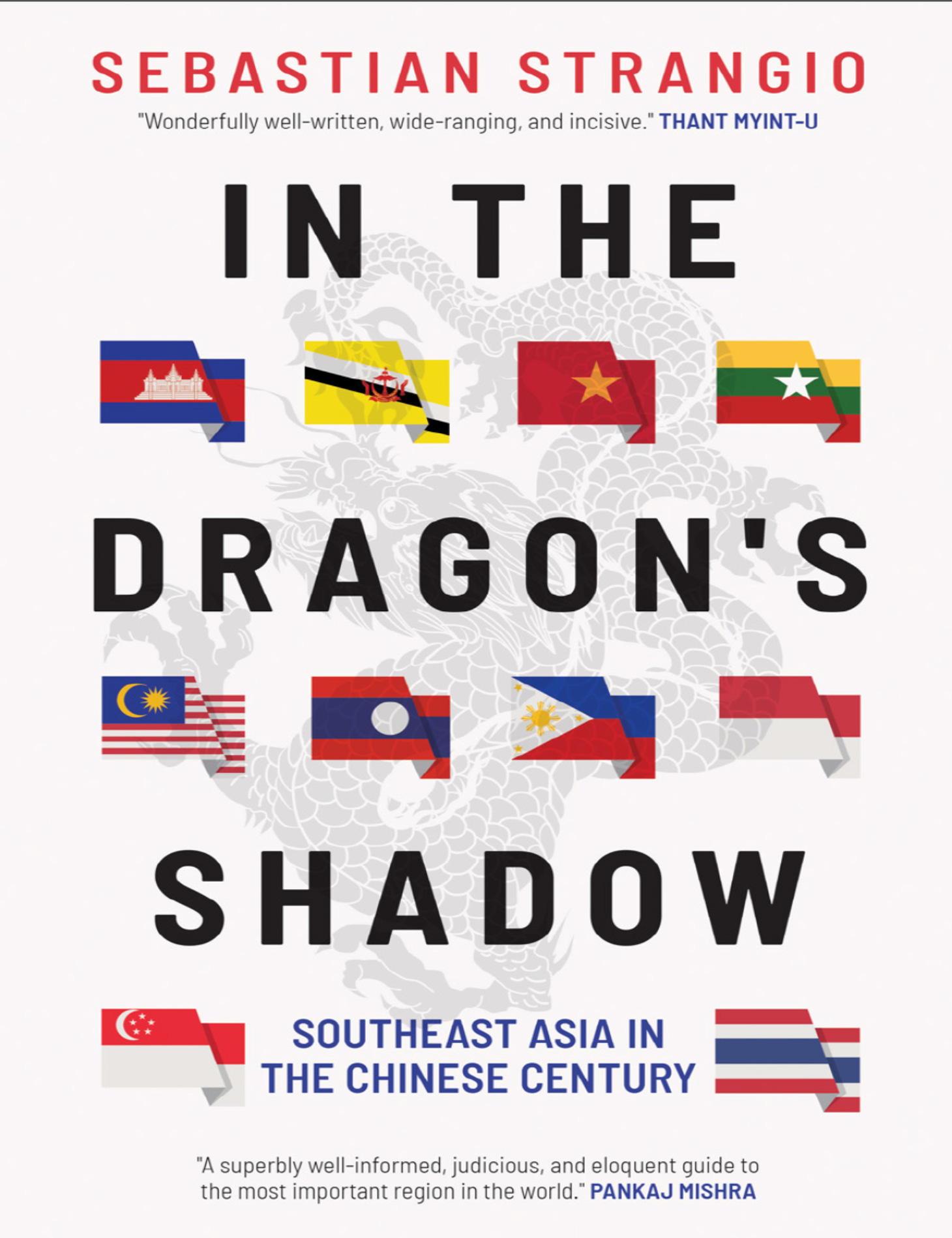
Sources: Sebastian Strangio, In the Dragon’s Shadow: Southeast Asia in the Chinese Century (Yale University Press, 2020), for the reported and historical material and for the ISEAS survey figures. Malacca transit counts for 2025 from the Malaysian Marine Department via the Nippon Maritime Center. Philippine government statements on the 2026 ASEAN chairmanship and the Code of Conduct timetable.